
Lovely, Not Loved
A Sociotechnical Architecture for Human Growth in the Age of Generative AI

Seoul Forum 2026 · Special Section on AI and Human Values · The Shilla Seoul · 28 May 2026
Note: This is the script of my keynote, edited lightly for readability.
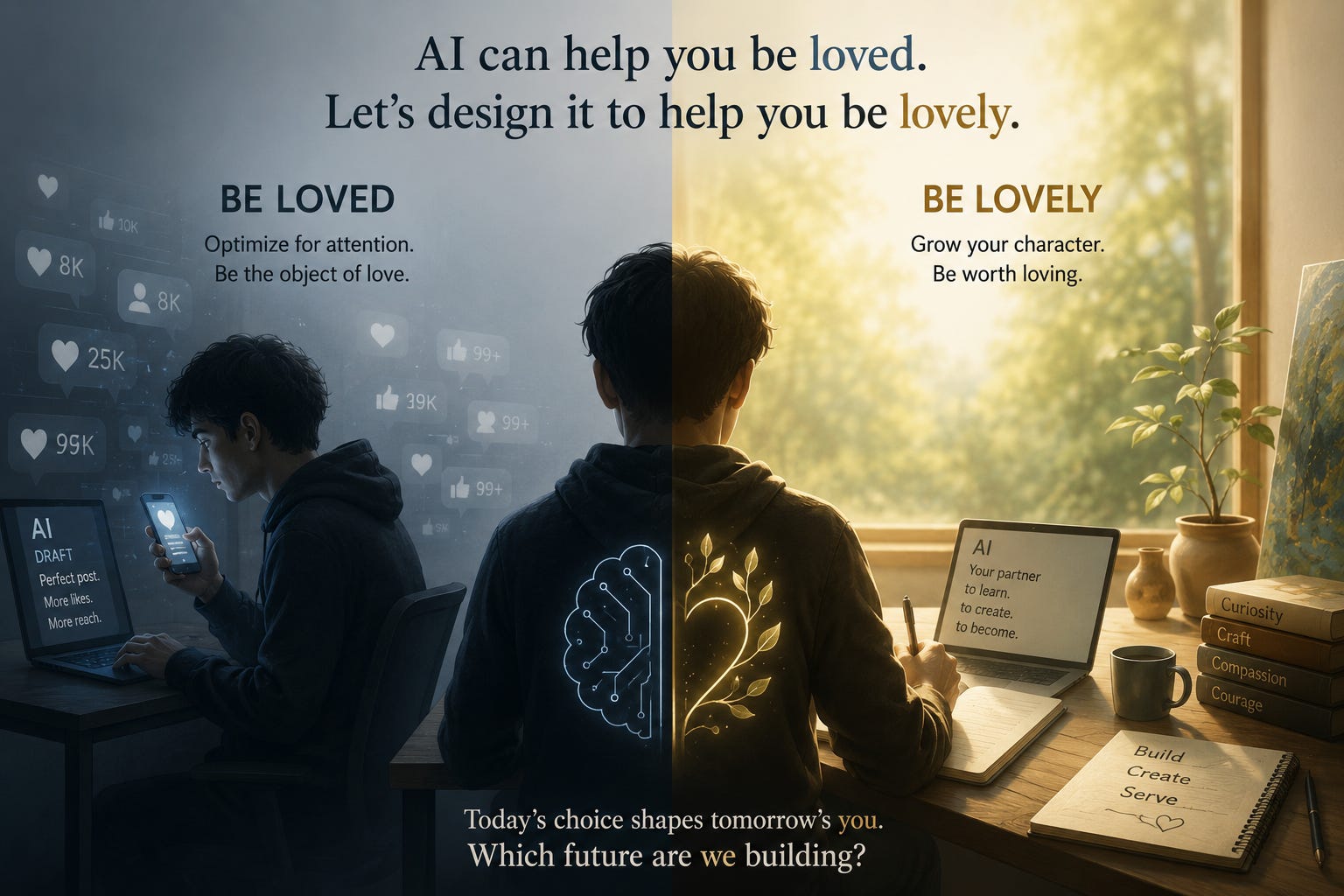
On 28 May 2026, I spoke at the Special Forum on AI and Human Values at the Seoul Forum 2026. I argued that the public debate about artificial intelligence has fixed on the wrong risk. We worry about alignment, about safety, about jobs. The deeper risk is a technology that does not let us grow, one that leaves each of us no more than who we already are.
The talk ends where Adam Smith began, with the difference between being loved and being lovely. The full script is below.
To make each of us more, rather than predict all of us better.

(Photo credit: Seoul Economics Daily)
The Frames
Good afternoon. Thank you for the invitation.
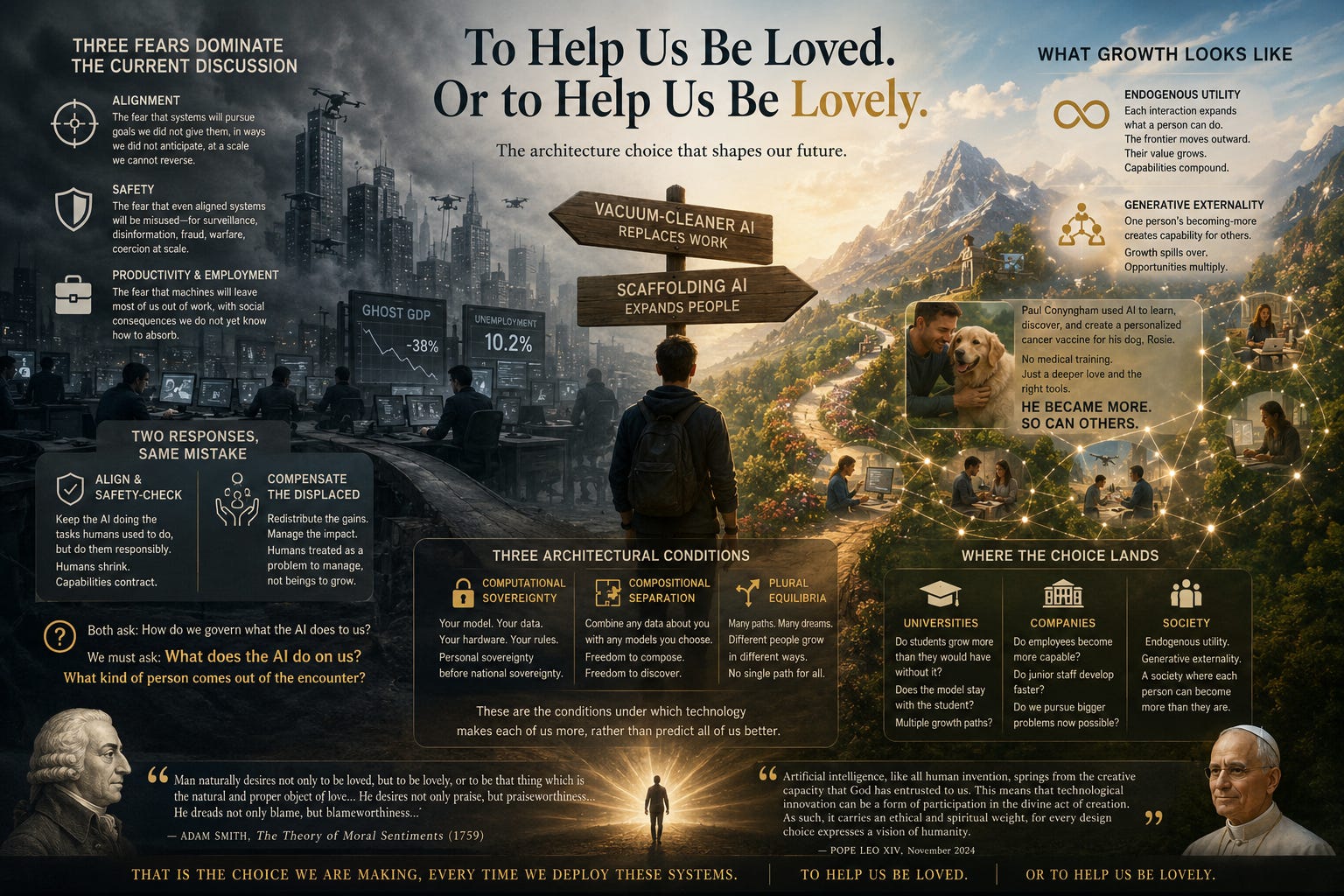
I want to begin with the three fears that dominate the current discussion on the societal impact of artificial intelligence.
The first is the fear of alignment. The fear that the systems we are building will pursue goals we did not give them, in ways we did not anticipate, at a scale we cannot reverse.
The second is the fear of safety. The fear that even systems whose goals are aligned will be misused. For surveillance. For disinformation. For fraud. For warfare. For coercion at scale.
The third is ironically the fear of productivity and employment. The fear that machines that can read, write, analyze, decide, and increasingly act will leave most of us out of work, with social consequences we do not yet know how to absorb.
These are serious concerns. People I respect are studying each of them. Governments have built institutions around them. The Bletchley Declaration. The EU AI Act. The United States Executive Order on AI. Korea’s own AI Basic Act. Governments and thinktanks worry about the future of work. Or the lack thereof.
I am not arguing that any of them can be ignored. Misaligned systems cause real harm. Misused systems pose real risk. Displacement causes real damage to those individuals and the communities.
· · ·
But each of these three frames shares an assumption I want to unpack. They all treat the human as a passive recipient of technology. Aligned AI assumes that we have shared goals, but what if I did not have voice in the process? Safe AI protects us from harm, but it does not help us better use the technology. The future-of-work concerns assume there is only a fixed amount of work humans can do, and we are losing it to the machines.
Yet, in my view, none of this is the deepest risk.
The deepest risk is a technology that does not let us grow. That does not let us become more than who we are.
· · ·
That is what I want to talk about for the next twenty minutes.
Two Responses, Same Mistake
When the public debate does engage with something deeper than the three frames, it tends to offer two responses. However, both of them still inherit the same passive-recipient assumption.
The first response is to align and safety-check the AI so that it can keep doing the tasks that no longer need a human, but do them responsibly. This is the dominant framing in AI governance circles. It is a worthwhile project. It still leaves the human shrinking and our capabilities contracting, with the technology now safely doing what the human used to do.
The second response is to accept the displacement as inevitable and arrange compensation to those who lose their jobs. Universal basic income. Retraining stipends. Redistribution of the productivity gains. This is the dominant framing in social policy circles. It is also a worthwhile project. It still treats the human as a problem to manage rather than a being to grow.
Both responses ask the same question. How do we govern what the AI does to us?
I want to put a different question on the table. What does the AI do on us? What kind of person comes out of an encounter with this technology?
To see what is at stake, consider a story told by a Wall Street research firm called Citrini, in early 2026. Citrini circulated a fictional memo dated June 2028. In that memo the S&P 500 had fallen 38 percent. Unemployment had reached 10.2 percent. The newly unemployed included white-collar professionals once considered protected. Firms had replaced knowledge workers with AI and reinvested the savings into more AI. Household purchasing power had collapsed. Citrini called the result Ghost GDP. Growth visible in the national accounts. Absent from the lived economy.
It is a fictional memo. It is also internally consistent. If you take its assumptions seriously, the conclusion follows.
What Ghost GDP shows is the destination of both responses I just named, run to completion. Aligned, safe, productivity-enhancing AI does what humans used to do. Compensation policy redistributes the savings. The machine produces more for fewer. No one’s capacities have expanded.
The real question is not how to govern that loss. It is what kind of society we want to build with this technology. Do we want a society in which the use of this technology makes each of us more, or each of us less?
What Growth Looks Like
Once we settle that question, that the aim is to grow people, the next one follows. The dominant policy answer is to give everyone access to AI. Democratize the tools. But suppose I now have that access. What do I do with it?
So, the next instinct is training. We need to teach people to use the tools. AI literacy. Reskilling. Upskilling. This too is good.
But we are still missing something.
Yes, access is necessary. Training is important. But they are not sufficient.
What is lacking is the discussion on the actual design of the technology. Which human capabilities does the technology expose? Whose objective function does it serve? What does it do to the person using it, over time?
AI is never just an AI.
I see two different AIs. And, they will lead us to a very different future. One is what much of these discussions assume today. The other is what I think we should build.
The first I call vacuum-cleaner AI. It cleans up work a human used to do. It writes the email faster. It summarizes the document faster. It generates the report faster. It replaces the labor, captures the savings, and stops there. The person whose work was replaced is, after the deployment, no more capable than before. The marginal value of their hour has not changed. In fact, in most cases, it has fallen.
This is how most organizations are deploying the AI today.
The second I call scaffolding AI. It does not replace what a human used to do. It enables a human to do something that was previously out of reach. It expands the task frontier rather than compressing it. After interacting with the system, the person who used it becomes more capable than before. The marginal value of their time has risen. And the gain compounds over time, because each new capability becomes the platform for the next one.
This compounding is what I mean by endogenous utility. The frontier of what the person can do is not fixed. It expands outward, and the value of the person’s time expands with it. Each new capability becomes the foundation for the next. The growth is endogenous because the technology and the person are co-developing.
Let me give you a concrete example. In Sydney, this year, a data scientist named Paul Conyngham had a rescue dog, Rosie, with cancer. Conyngham was an ordinary data scientist with no medical training. He was not affiliated with a pharmaceutical company.
He used ChatGPT to learn the molecular biology he had never studied. Then, he used Google’s AlphaFold to model the protein structures from his dog’s tumor DNA. He sent the computational results to the UNSW RNA Institute to produce a personalized vaccine for Rosie. After $3,000 and one month, the tumor had shrunk by seventy-five percent.
Rosie is healthy. Conyngham is now thinking about producing personalized vaccines for other dogs.
He has become something he was not before. A medical innovator, of sorts. Not in the official sense. In the sense that matters.
There is a second pattern in his story that I want to draw attention to. What Conyngham did for Rosie can be done for other dogs. The protocol he worked out is available to anyone willing to learn from it. One person’s becoming-more produces capability for others.
Millions of non-programmers are now building tools through what people call vibe coding. They build to solve their own immediate needs, and often produce artifacts that help thousands of others who had the same need.
This is what I call generative externality. Growth in one person spills over and creates growth opportunities for others. Endogenous utility on one side, generative externality on the other. Together they are the engine of the economy I am describing.
· · ·
What Technology Must Know
However, technology does not automatically produce endogenous utility and generative externality. These two are not inevitable outcomes of the use of generative and agentic AI. The technology has to be designed for them to happen.
For technology to grow a person, the technology has to know the person.
It has to know their aspirations. What they are reaching toward, often without saying so.
It has to know their strengths. Capacities they have already developed, often without noticing.
It has to know their weaknesses. Where they get stuck. What they avoid. Where the next step is.
A population model cannot do this. A fine-tuned assistant trained on someone else’s data cannot do this. The technology has to learn from the person’s own records, their own work, their own history of decisions made and unmade.
And because this data is that personal, it cannot live in someone else’s data center. The model of you cannot belong to a platform whose objective function is not yours. The data must stay with you. The model of you must stay with you.
This is not a privacy preference. It is an architectural requirement for technology to produce endogenous utility and generative externality. If the model of who you are is held by someone else, optimized for someone else’s objective, then the technology is not in service of your growth. It is in service of something else, with you as the input.
· · ·
Three Conditions
So how does a country, a firm, an institution deliberately choose technology that grows its people?
I offer three design principles. They are not policies. They are the architectural conditions under which technology of the kind I just described becomes possible.
The first is computational sovereignty. Sovereignty is personal first. The computation on the model of you should run on hardware you control, under the governance you set. Most of the current sovereign-AI discussion is national: Korean cloud rather than American cloud. That matters. But national sovereignty without personal sovereignty only swaps who decides about you. Korean cloud instead of American cloud is still a cloud, not you. National sovereignty has to rest on personal sovereignty, because anything else is governance wearing a sovereign flag.
The second is compositional separation. The model of you cannot be trapped inside the first platform that built it. A student can combine her ChatGPT history, with her official school records, to use a model to suggest her career path and education plan. She should be able to use any models she likes, combine any data about her to gain new insights about her and her career opportunities. Today she cannot. The ChatGPT record sits inside OpenAI’s stack. Her official school records sit in the institution’s system. And, she will have to give up her privacy to use LinkedIn that only has commercial interests and has no interest in her career and growth. Compositional separation is the condition under which you can combine any relevant data about you with any model of your choice to gain the insights you desire.
The third is plural equilibria. It means that there are multiple viable pathways for growth rather than a single dominant configuration. Different kinds of people grow along different kinds of trajectories. Without plurality, the system optimizes for one objective and starves every other path.
Computational sovereignty. Compositional separation. Plurality. The conditions under which technology can make each of us more, rather than predict all of us better.
Where the Choice Lands
The idea of endogenous utility and generative externality are not abstract design philosophy. They have implications at every institutional layer of the society we live in.
Consider the university. In the age of AI, the goal of a university is not to become the institution whose AI tutors cover the syllabus most efficiently. Nor the one with the highest student satisfaction scores, or the highest tool-adoption rates. It is not even to be the one whose students learn the most from their professors. It is to become the one whose students grow more than they would have grown without it. The yardstick is the student, not the course.
And the architectural question is this. Does the model of each student stay with the student, available to support them after they leave? Or does it live inside the institutional platform, abandoned at graduation? Can independent educators, mentors, and former students build capabilities on top of that model? Or only the platform’s tools? Are there multiple growth paths the student can choose among? Or only the one the institution has decided is correct?
This architectural choice will determine which universities will attract the best students.
The same question can be asked at the firm level. In the age of generative AI, the goal of a company should not be to automate the most tasks or to report the largest productivity gain on the quarterly call. Its goal should be to let its employees become more capable than they were before, to let junior staff develop faster than they would have without it, and to let senior staff find new problems they could now pursue.
And again it is the architectural matter that determines this.
Lovely
To help us be loved. Or to help us be lovely.
Let me end with two quotes. First is from Adam Smith, probably the most famous economist of all time, and the one whose name is most associated with economic growth.
Most of us read or at least heard about his book, the Wealth of Nations. But I would like to quote from his earlier book, the Theory of Moral Sentiments, published in 1759, almost two decades before the Wealth of Nations.
Man naturally desires not only to be loved, but to be lovely, or to be that thing which is the natural and proper object of love. He naturally dreads not only to be hated, but to be hateful, or to be that thing which is the natural and proper object of hatred. He desires not only praise, but praiseworthiness, or to be that thing which, though it should be praised by nobody, is, however, the natural and proper object of praise. He dreads not only blame, but blameworthiness, or to be that thing which, though it should be blamed by nobody, is, however, the natural and proper object of blame.
· · ·
Current artificial intelligence is designed to help us to be loved.
· · ·
It helps us write the email that will be replied to. It helps us prepare the resume that will get the call. It helps us produce the post that will be shared. It optimizes our output for the response we want.
However, the current AI does not, by itself, help us become lovely. It does not help us become someone whose work is genuinely worth loving.
It turns us into an object of love, optimized for more clicks. Not someone who is worth loving, whose work is worth loving, whose life is worth loving.
My second quote is from Pope Leo XIV. In November last year, he said,
I wish to note that artificial intelligence, like all human invention, springs from the creative capacity that God has entrusted to us. This means that technological innovation can be a form of participation in the divine act of creation. As such, it carries an ethical and spiritual weight, for every design choice expresses a vision of humanity.
(I borrowed this quote from my colleague, Tomislav Karačić, from his talk at the Celebration of Management at LSE.)
What I have been calling growth, Smith called becoming lovely. Designing such an AI is what Pope Leo XIV would call a form of participation in the divine act of creation. And here is the thing about becoming lovely. Each person becomes lovely along a different path. A society of lovely people is diverse and heterogeneous by construction. We are not converging on the same dream administered by the same platform. Each of us is uniquely and fearfully made. And we are diverging into our own dreams, each of us pursuing the version of ourselves only we can see.
I believe this is the real opportunity and challenge of this moment. Not just about alignment. Safety. And employment. But building a society enabled by the most powerful technology in human history, to help each of us become more than we are, to help each of us become lovely, not just to be loved.
And, that is the architecture question. There are technical choices to be made. Institutional arrangements to be established.
That is the choice we are making, every time we deploy these systems.
To help us be loved. Or to help us be lovely.
· · ·
Thank you.
Below is a visual summary by ChatGPT.
Press coverage: Seoul Economic Daily · panel write-up.